



Rotorless Rheometer: Applications, International Standards, and Industry Trends in Rubber Testing
Rotorless Rheometer: Applications, International Standards, and Industry Trends in Rubber Testing
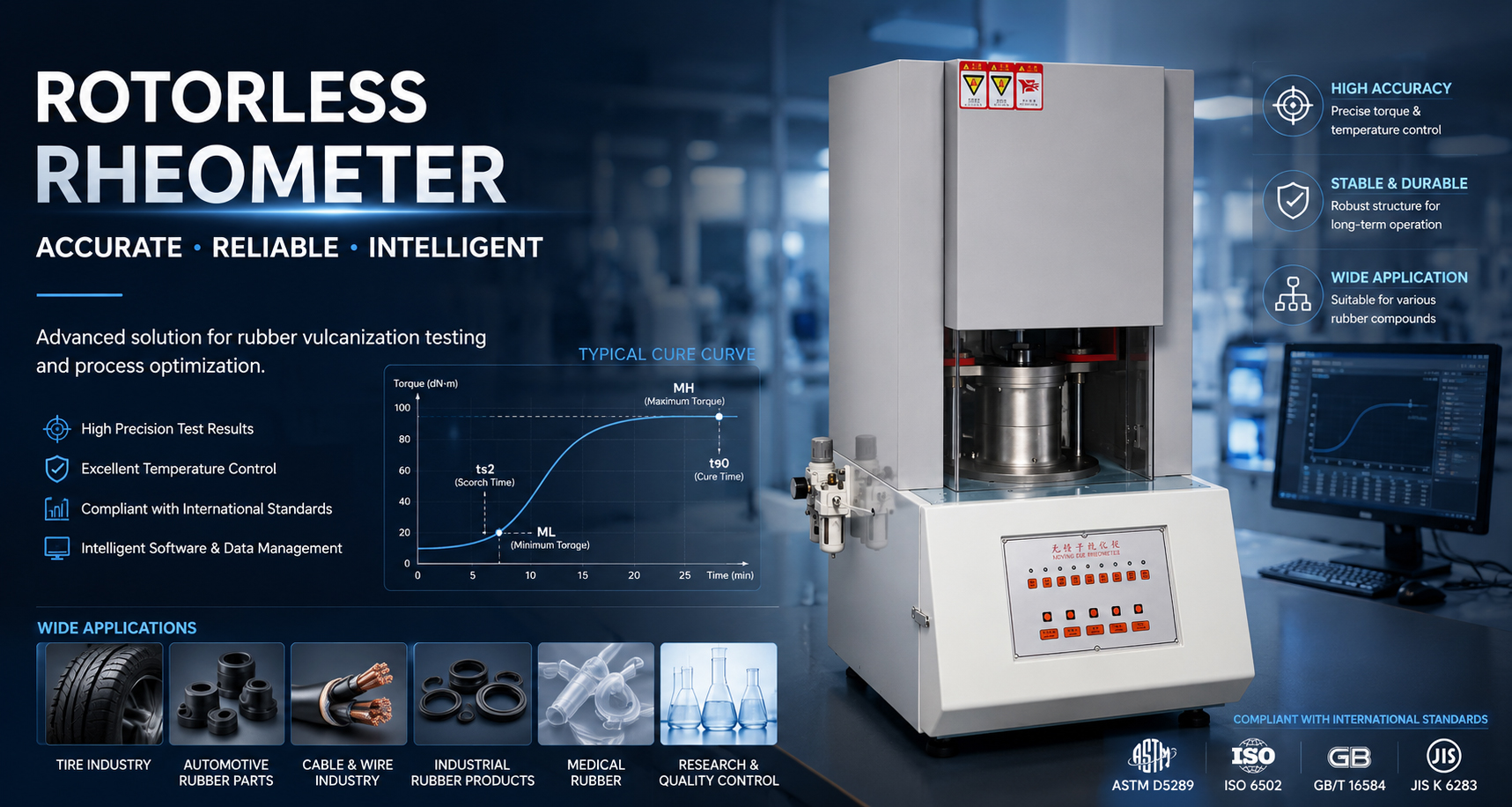
As the global rubber industry continues to expand, manufacturers are placing greater emphasis on product quality, production efficiency, and material consistency. Industries such as tire manufacturing, automotive components, wire and cable production, medical devices, and industrial rubber products all rely heavily on precise rubber testing during the vulcanization process.
Among the most important testing instruments in the rubber industry, the Rotorless Rheometer has become an essential solution for evaluating rubber curing characteristics and optimizing production processes.
This article provides a comprehensive overview of rotorless rheometers, including their working principles, major application industries, relevant international testing standards, core advantages, and future development trends.
What Is a Rotorless Rheometer?
A Rotorless Rheometer is a precision laboratory instrument used to measure the vulcanization characteristics of rubber compounds. It evaluates key curing parameters such as torque, scorch time, cure time, and curing rate during the vulcanization process.
Compared with traditional moving-die or rotor-type rheometers, rotorless rheometers utilize a sealed cavity design without a rotating rotor, which significantly reduces mechanical wear and improves testing repeatability and accuracy.
By applying controlled temperature and oscillating movement to a rubber sample, the instrument continuously records changes in material properties during curing. The resulting data helps manufacturers optimize rubber formulations, improve product consistency, and reduce production defects.
Working Principle of a Rotorless Rheometer
A typical rotorless rheometer consists of:
-
Temperature control system
-
Sealed die cavity system
-
Torque sensing system
-
Data acquisition and analysis software
During the testing process:
-
A rubber sample is placed inside the sealed cavity;
-
The upper and lower dies close under controlled pressure;
-
The cavity oscillates at a small angle and fixed frequency;
-
Sensors measure torque changes during vulcanization;
-
The software generates curing curves and test reports automatically.
The rheometer provides important curing parameters including:
-
Minimum Torque (ML)
-
Maximum Torque (MH)
-
Scorch Time (ts2)
-
Optimum Cure Time (t90)
-
Cure Rate Index (CRI)
-
Cure Stability Characteristics
These parameters are critical for rubber formulation development, process optimization, and quality assurance.
Major Applications of Rotorless Rheometers
1. Tire Manufacturing Industry
The tire industry is one of the largest application sectors for rotorless rheometers.
Modern tires require excellent durability, wear resistance, traction performance, and heat resistance. Precise control of rubber vulcanization is essential to ensure product safety and performance.
Rotorless rheometers help tire manufacturers:
-
Optimize rubber formulations
-
Control vulcanization cycles
-
Improve batch consistency
-
Reduce scrap rates
-
Increase production efficiency
Applications include:
-
Passenger car tires
-
Truck and bus tires
-
Off-road tires
-
Motorcycle tires
-
Aircraft tires
2. Automotive Rubber Components
The automotive industry uses a wide range of rubber components, including:
-
Sealing strips
-
Rubber hoses
-
O-rings
-
Anti-vibration parts
-
Engine rubber components
-
Dust covers
These products require excellent heat resistance, oil resistance, and long-term durability.
Rotorless rheometers allow manufacturers to evaluate curing behavior accurately and ensure stable product quality.
3. Wire and Cable Industry
Rubber insulation and sheath materials used in electrical cables must maintain reliable performance under high temperatures and harsh operating conditions.
Rotorless rheometers are widely used for:
-
Cable sheath testing
-
Insulation material analysis
-
High-temperature vulcanization studies
-
Compound consistency verification
This is especially important for:
-
High-voltage cables
-
Fire-resistant cables
-
New energy cables
-
Industrial power cables
4. Medical Rubber Products
Medical rubber products require extremely high standards for cleanliness, stability, and safety.
Rotorless rheometers are commonly used in the production of:
-
Medical stoppers
-
Silicone rubber products
-
Medical tubing
-
Medical seals
-
Medical gloves
Accurate curing analysis helps ensure reliable physical properties and product safety.
5. Research Institutes and Universities
Rotorless rheometers are also widely used in laboratories and research centers for advanced rubber material studies.
Researchers use these instruments to investigate:
-
New rubber compounds
-
Nano-filled rubber materials
-
Bio-based rubber
-
Sustainable rubber formulations
-
Vulcanization kinetics
The data generated by rheometers plays an important role in material innovation and process development.
International Standards for Rotorless Rheometer Testing
To ensure reliable and globally comparable test results, rotorless rheometer testing is commonly performed according to international standards.
Below are several important standards widely recognized in the rubber industry.
ASTM D5289
ASTM D5289 is one of the most widely adopted international standards for rubber vulcanization testing.
Official Title:
"Standard Test Method for Rubber Property—Vulcanization Using Rotorless Cure Meters"
The standard specifies:
-
Rotorless rheometer testing procedures
-
Temperature control requirements
-
Oscillation angle specifications
-
Data recording methods
-
Calculation of curing parameters
ASTM D5289 is extensively used in global tire and rubber manufacturing industries.
ISO 6502
ISO 6502 is an important international standard developed by the International Organization for Standardization.
Official Title:
"Rubber — Guide to the Use of Curemeters"
This standard covers:
-
Guidelines for curemeter operation
-
Test procedure requirements
-
Calibration methods
-
Data interpretation practices
ISO standards are highly recognized in Europe and international markets.
GB/T 16584
GB/T 16584 is a widely used Chinese national standard for rotorless rheometer testing.
Official Title:
"Rubber — Determination of Vulcanization Characteristics Using Rotorless Cure Meters"
The standard is developed based on international testing methods and is commonly applied in China‘s rubber manufacturing industry.
JIS K6300
JIS K6300 is a Japanese industrial standard related to rubber physical testing.
It is widely used in Japan‘s automotive and electronics industries, where high testing precision and stability are essential.
Key Advantages of Rotorless Rheometers
Compared with traditional curing test equipment, rotorless rheometers offer several important advantages.
High Repeatability
The rotorless design minimizes mechanical wear and improves testing consistency.
Excellent Sealing Performance
The sealed cavity structure prevents sample leakage and enhances measurement accuracy.
Precise Temperature Control
Advanced temperature systems maintain stable testing conditions and reduce experimental variation.
Easy Operation
Modern rheometers are equipped with intelligent software for automatic testing, curve generation, and data analysis.
Traceable Data Management
Testing data can be stored, exported, and printed for quality management and production traceability.
Future Trends in Rotorless Rheometer Technology
With the rapid development of Industry 4.0 and intelligent manufacturing, rubber testing equipment is becoming increasingly automated and digitalized.
Future rotorless rheometers are expected to feature:
Intelligent Data Analysis
AI-based algorithms and big data technologies will help optimize curing parameters and predict production abnormalities.
Automated Testing Systems
Integration with robotic sample loading systems will enable fully automated testing processes.
Cloud-Based Data Management
Remote monitoring and cloud storage will allow centralized management across multiple factories.
Higher Precision Sensors
Advanced sensor technologies will further improve testing sensitivity and stability.
Energy-Efficient Design
Modern equipment will focus on reducing energy consumption and supporting sustainable manufacturing.
How to Choose the Right Rotorless Rheometer
When selecting a rotorless rheometer, manufacturers should consider the following factors:
-
Compliance with ASTM, ISO, and other international standards
-
Temperature control accuracy
-
Torque measurement range
-
Testing repeatability
-
Software functionality
-
Data management capability
-
Technical support and after-sales service
-
Equipment durability and stability
A high-quality rotorless rheometer not only improves testing efficiency but also enhances overall product quality and market competitiveness.
Conclusion
As one of the most important testing instruments in the rubber industry, rotorless rheometers play a critical role in tire manufacturing, automotive components, wire and cable production, medical rubber products, and research applications.
With increasing global demand for product quality, precision testing equipment that complies with international standards is becoming essential for modern rubber manufacturing.
As a professional manufacturer of rubber testing equipment, we remain committed to technological innovation and delivering reliable, accurate, and intelligent testing solutions to customers worldwide.
For more information about our Rotorless Rheometers and rubber testing solutions, please feel free to contact us.
 RainbowHe
 Rainbow He
 Mailme
 Rainbow He